Maundy Thursday, April 9
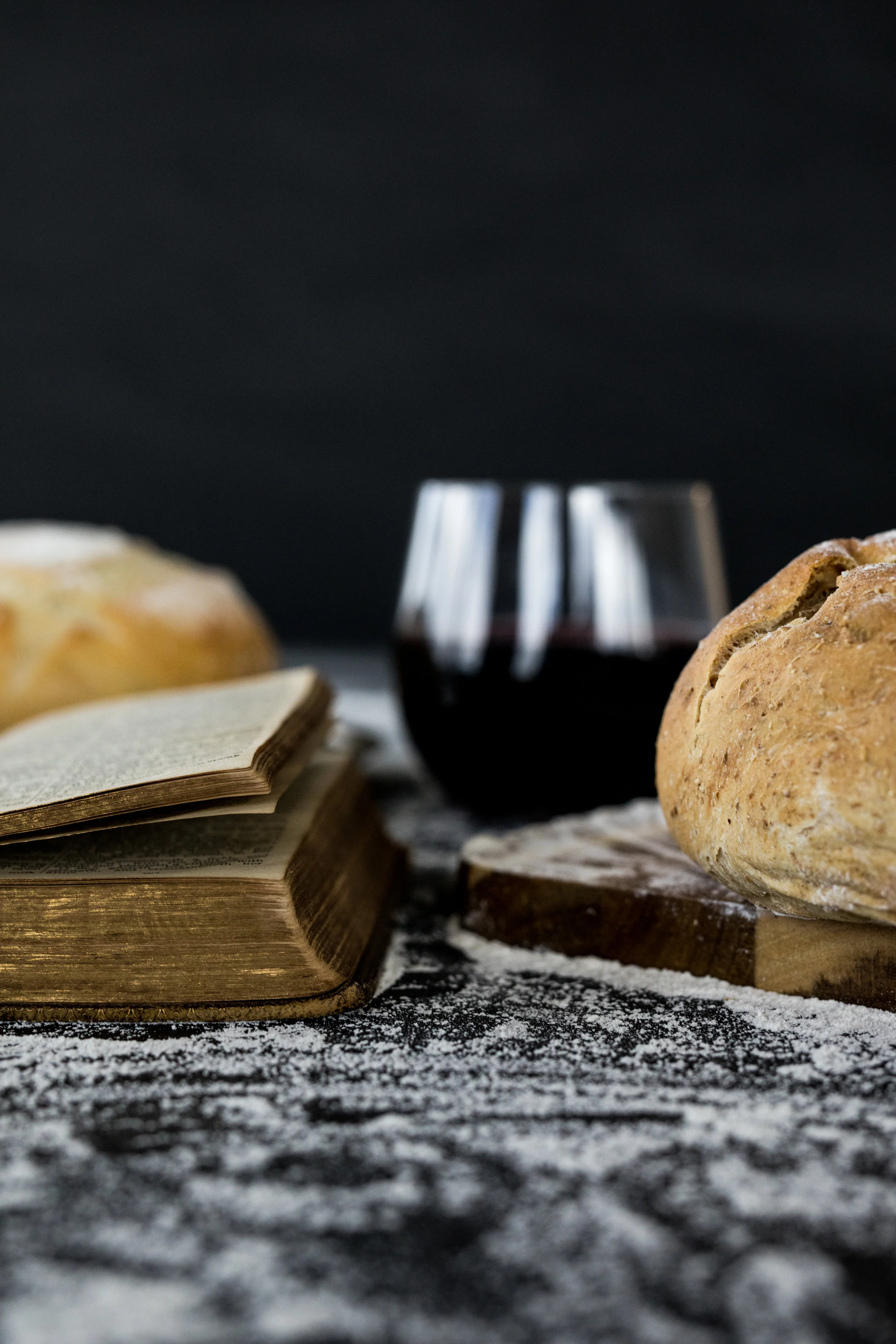
While they were eating, Jesus took bread, and when he had given thanks, he broke it and gave it to his disciples, saying, “Take and eat; this is my body.”
Matthew 26:26-30
While they were eating, Jesus took bread, and when he had given thanks, he broke it and gave it to his disciples, saying, “Take and eat; this is my body.”
Then he took a cup, and when he had given thanks, he gave it to them, saying, “Drink from it, all of you. This is my blood of the covenant, which is poured out for many for the forgiveness of sins. I tell you, I will not drink from this fruit of the vine from now on until that day when I drink it new with you in my Father’s kingdom.”
When they had sung a hymn, they went out to the Mount of Olives.
Jesus gathered with his disciples for the passover seder meal, special time when Jews remembered God’s delivery of Israel from slavery in Egypt.
When the bread was lifted up at Passover, the head of the meal said: “This is the bread of affliction which our fathers ate in the land of Egypt. Let everyone who hungers come and eat; let everyone who is needy come and eat the Passover meal.” During the Passover meal, every bite had symbolic meaning. The bitter herbs recalled the bitterness of slavery; the salt water remembered the tears shed under Egypt’s oppression. The main course of the meal – a lamb freshly sacrificed for that particular household was meant to remember the lamb’s blood spread across the doors of every household in order that they may be spared for the plague of the angel of death.
If you want to understand the story of the delivery of God’s people from Egypt, turn to the book of Exodus in the Bible, read chapters 8-13, focusing on chapter 13.
Consider the passover meal when you think of Jesus and his disciples eating together. Jesus didn’t give the normal explanation of the meaning of each of the foods. He reinterpreted them so that the meaning turned from God’s delivery from Egypt to God’s delivery from sin.
As the bread was broken, Jesus declared that it was his body, the bread symbolized that Jesus, the Bread of Life, would soon be broken for the delivery of humanity from sin.
As the wine was blessed, Jesus said. “This is my blood of the covenant.” What was he talking about? He was telling the disciples that Jesus, the lamb of God, would shed his blood for us. The spotless lamb whose blood was painted on the doorways of the Israelites in Egypt in order to be delivered was replaced by the Blood of Jesus, the Lamb of God.
Maundy Thursday is the day we remember Jesus' last supper, the newly revised passover meal, with his disciples. We usually observe this day by sharing communion, also known as the Lord’s Supper. Unfortunately, we will not be meeting for that this year. Instead, let’s read part of our communion liturgy in order to remember Christ’s sacrifice of love in order to deliver us from sin:
The Lord be with you.
And also with you.
Lift up your hearts.
We lift them up to the Lord.
Let us give thanks to the Lord our God.
It is right to give our thanks and praise.
It is right, and a good and joyful thing,
always and everywhere to give thanks to you,
Father Almighty, creator of heaven and earth.
You formed us in your image
and breathed into us the breath of life.
When we turned away, and our love failed,
your love remained steadfast.
You delivered us from captivity,
made covenant to be our sovereign God,
and spoke to us through the prophets.
And so, with your people on earth
and all the company of heaven
we praise your name and join their unending hymn:
Holy, holy, holy Lord, God of power and might,
heaven and earth are full of your glory.
Hosanna in the highest.
Blessed is he who comes in the name of the Lord.
Hosanna in the highest.
Holy are you, and blessed is your Son Jesus Christ.
Your Spirit anointed him
to preach good news to the poor,
to proclaim release to the captives
and recovering of sight to the blind,
to set at liberty those who are oppressed,
and to announce that the time had come
when you would save your people.
He healed the sick, fed the hungry, and ate with sinners.
By the baptism of his suffering, death, and resurrection
you gave birth to your Church,
delivered us from slavery to sin and death,
and made with us a new covenant
by water and the Spirit.
When the Lord Jesus ascended,
he promised to be with us always,
in the power of your Word and Holy Spirit.
On the night in which he gave himself up for us,
he took bread, gave thanks to you, broke the bread,
gave it to his disciples, and said:
"Take, eat; this is my body which is given for you.
Do this in remembrance of me."
When the supper was over, he took the cup,
gave thanks to you, gave it to his disciples, and said:
"Drink from this, all of you;
this is my blood of the new covenant,
poured out for you and for many
for the forgiveness of sins.
Do this, as often as you drink it,
in remembrance of me."
And so,
in remembrance of these your mighty acts in Jesus Christ,
we offer ourselves in praise and thanksgiving
as a holy and living sacrifice,
in union with Christ's offering for us,
as we proclaim the mystery of faith.
Christ has died; Christ is risen; Christ will come again.
Through your Son Jesus Christ,
with the Holy Spirit in your holy Church,
all honor and glory is yours, almighty God,
now and forever. Amen.
Pray: Lord, you sacrificed your life for me, to deliver me from slavery to sin and death. As I remember your gift of great love today, I am humbled at your act of salvation. Thank you. Amen.

Wednesday, April 8
Then one of the Twelve—the one called Judas Iscariot—went to the chief priests and asked, “What are you willing to give me if I deliver him over to you?” So they counted out for him thirty pieces of silver. From then on Judas watched for an opportunity to hand him over.Matthew 26:14 -16
Then one of the Twelve—the one called Judas Iscariot—went to the chief priests and asked, “What are you willing to give me if I deliver him over to you?” So they counted out for him thirty pieces of silver. From then on Judas watched for an opportunity to hand him over.
I’ve heard sermons abut how we ought to shake our heads and wag our fingers at Judas for his betrayal. Other sermons I’ve heard on this passage were about us asking, “How do I betray Jesus?”
Both of these are valid lessons in their time and setting, but today I want to hear something new. What lesson can we glean from the story of Judas’ betrayal?
The 30 pieces of silver bare a great deal of significance in the agreement Judas made with the chief priests. 30 pieces of silver was the price for a slave.
Judas went to the chief priests and asked, “What are you willing to give me if I deliver him over to you?” The price the quoted was that of a slave, a slave!
This payment and subsequent betrayal began a terrible episode of degrading acts. Jesus was spit upon like a slave, beaten like a slave, mocked like a slave, and otherwise abused like a slave of a tyrant..
Today, we understand that nobody EVER should be forced into slavery or treated the way Jesus was treated, but in that time, in that place, Jesus was treated as those in forced servitude were treated. In fact, Jesus was subjected to more than any servant would hav endured.
So there we have it - our Lord cast aside and treated in the most horrific manner, all for the price of a slave.
As I reflect on this I come to the realization that I too, have traded Jesus for pittance. Easter eggs, chocolate, fluffy bunnies, and baskets - all trinkets put ahead of our savior.
Today I find myself more than willing to forgo all of the usual Easter falderal. The thirty pieces of silver are not what I seek today. Today, I want the strength to desire only Jesus, my Lord and my Savior.
Pray: Lord, keep me on track. Let me not be greedy for silver, baskets, chocolate, or even a ham dinner. Instead give me the strength and wisdom to seek you and you only. Amen.

Tuesday, April 7
Very truly I tell you, you will weep and mourn while the world rejoices. You will grieve, but your grief will turn to joy. A woman giving birth to a child has pain because her time has come; but when her baby is born she forgets the anguish because of her joy that a child is born into the world. So with you: Now is your time of grief, but I will see you again and you will rejoice, and no one will take away your joy.
John 16:16-22
Jesus went on to say, “In a little while you will see me no more, and then after a little while you will see me.”
At this, some of his disciples said to one another, “What does he mean by saying, ‘In a little while you will see me no more, and then after a little while you will see me,’ and ‘Because I am going to the Father’?” They kept asking, “What does he mean by ‘a little while’? We don’t understand what he is saying.”
Jesus saw that they wanted to ask him about this, so he said to them, “Are you asking one another what I meant when I said, ‘In a little while you will see me no more, and then after a little while you will see me’? Very truly I tell you, you will weep and mourn while the world rejoices. You will grieve, but your grief will turn to joy. A woman giving birth to a child has pain because her time has come; but when her baby is born she forgets the anguish because of her joy that a child is born into the world. So with you: Now is your time of grief, but I will see you again and you will rejoice, and no one will take away your joy.
This conversation between Jesus and the disciples happened just days before Jesus was arrested. He was preparing the disciples for difficult time ahead, and the pain and grief they will experience through the last days of Jesus’ life. He knows the hurt they will feel, and so he shares words of hope with them.
“In a little while I will be gone, BUT soon enough you will see me again. You will grieve while those who arrest me will rejoice in my execution, BUT that will only last for a time. Soon enough I will bring new life!”
The next part is one we can surely identify with, especially moms. Childbirth is hard and painful, there are tears, groans, and even shouts of agony, BUT as soon as the little one is born all of the pain is forgotten. Why? Because the pain pails in comparison to the joy of new life.
We have the benefit of knowing the end of the story. The disciples did not know the gravity of the coming events. In a way, I envy them. They experienced imaginable pain and grief upon Jesus death, but the also experience the joy of his resurrection far more than we ever will.
Right now there is great pain in the world, unfathomable sorrow surrounds us. Though we cannot understand the grief of the disciples, we can certainly feel the depth of sorrow that exists in the face of COVID-19.
In the midst of this terrible time, let’s walk through the last days of Jesus’ life with this in mind:
Jesus knows our pain, and he offers us words of hope. The pain we experience now will eventually pail in comparison to new life.
Pray: Lord God, we are lost, confused, and just starting to process the gravity of this terrible time in the world. You, however, offer us hope. This week, while we remember your pain, help us hold on to that which came after - new life. Amen